Dog Enrichment
How to Use a Snuffle Mat: A Step-by-Step Guide for Beginners

Quick answer: Here is how to use a snuffle mat: lay it flat on the floor, scatter a few dry treats on top so your dog wins right away, then say a cue like "Find it!" and let them sniff. Over the next few sessions, hide kibble deeper in the fabric. Always supervise, pick the mat up when the food is gone, and wash it on a gentle cycle once a week or whenever it smells.
A snuffle mat looks almost too simple: a square of fleece with food hidden inside. But how you use a snuffle mat in the first week decides whether your dog loves it, ignores it, or tries to eat it. This guide walks you through a 5-step method, a 2-week plan to build up the challenge, fixes for the most common problems, and the safety and cleaning rules most sellers leave out.
Key takeaways
- Start easy: food on top of the mat, not buried. Early wins build interest.
- Use dry kibble or small dry treats only. Wet food belongs on a lick mat.
- A snuffle mat is a supervised game, not a chew toy. Put it away after every session.
- Count snuffle-mat food as part of your dog's daily ration to avoid overfeeding.
- It complements walks and play. It doesn't replace them.
In this guide
What is a snuffle mat (and why does it work)?
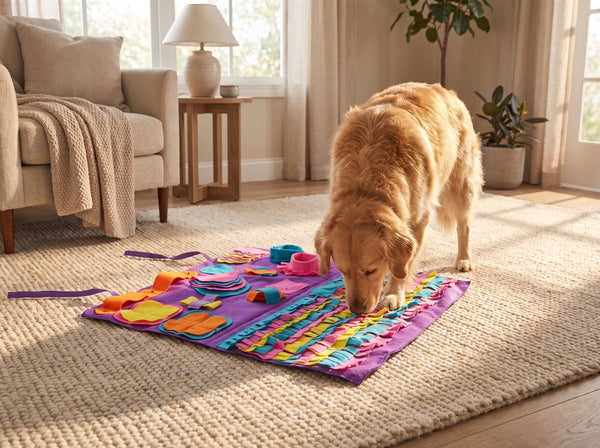
A snuffle mat is a fabric foraging mat: a backing covered in fleece strips, flaps and pockets where you hide kibble or treats. Your dog uses their nose to find each piece instead of eating from a bowl.
It works because it turns eating into what dogs are built to do: sniff and search. The American Kennel Club describes snuffle mats as a way to slow down fast eaters, provide mental enrichment, and keep dogs busy indoors when the weather limits outdoor exercise (AKC). In practice, that means three everyday benefits:
- Slower meals. Each piece of kibble has to be found, so a meal that disappears in seconds from a bowl takes several minutes.
- Mental exercise. Sniffing and problem-solving give a bored dog something to focus on.
- A calm indoor activity. Useful for rainy days, apartment life, puppies and senior dogs who can't do long walks.

What you need before you start
- A snuffle mat sized for your dog. Medium and large dogs need room to search; a small mat gets "solved" in seconds.
- Dry food: your dog's regular kibble, or small, strong-smelling dry treats for the first sessions.
- A quiet spot on a non-slip floor, away from other pets.
- 5 minutes of your time to stay close and supervise.
How to use a snuffle mat in 5 steps
Step 1: Let your dog discover the mat (food on top)
Lay the mat flat and drop 5 to 10 treats on top of the fleece, where they're easy to see and smell. Let your dog investigate freely. The goal of the first session is simple: your dog learns that this new object means food. Keep it short, two or three minutes, and stop while they're still interested.
Step 2: Add a cue like "Find it!"
Ask your dog to sit or wait while you scatter the food, then release them with a cue such as "Find it!" or "Search!". The AKC suggests exactly this routine: have your dog wait while you fill the mat, then teach a start cue (AKC). It adds a mini training session and stops your dog from diving in while you're still hiding food.
Step 3: Hide the food deeper, gradually
Once your dog finds food on top without hesitation, start tucking pieces between the strips, then under flaps and inside pockets. Increase the difficulty a little at a time. If your dog gives up, walks away or starts pawing hard, go back one level. Success keeps them engaged; frustration turns the game into a chewing session.

Step 4: Use it for real meals
When your dog is comfortable, serve part or all of a dry meal in the mat. This is where a snuffle mat shines for fast eaters. Measure the food first, and remember that every treat counts: subtract snuffle-mat food from your dog's daily portion so the game doesn't add extra calories.
Step 5: End the session and put the mat away
When the food is gone, pick the mat up. An empty mat left on the floor quickly becomes a chew toy. Putting it away also keeps it special, so your dog stays excited the next time it comes out.
Tip: most dogs spend about 10 to 15 minutes searching a well-filled mat. The exact time depends on how much food you hide, how deep, and your dog's experience.
A simple 2-week plan to build up difficulty
The easiest way to learn how to use a snuffle mat with a new dog is to raise the challenge in small steps. Here is the plan we recommend:
| When | How to fill the mat | Goal |
|---|---|---|
| Days 1–3 | 5–10 strong-smelling treats on top of the fleece | Your dog links the mat with food |
| Days 4–7 | Half on top, half tucked between the strips; add the "Find it!" cue | Your dog starts using their nose to search |
| Days 8–14 | Part of a dry meal, hidden deeper, under flaps and in pockets | Slower meals and longer focus |
| After 2 weeks | Full dry meals, rotate hiding spots, use the hardest zones | Daily enrichment routine |
Snuffle mat vs. slow feeder bowl vs. puzzle toy vs. lick mat
These tools are often compared, but they do different jobs. Here's how they stack up:
| Tool | Best for | Food type | Main limit |
|---|---|---|---|
| Snuffle mat | Fast eaters, bored dogs, sniffing and mental exercise | Dry kibble, dry treats | Needs supervision and regular washing |
| Slow feeder bowl | Slowing meals with zero setup | Dry or wet | Little mental challenge once learned |
| Puzzle toy | Problem-solving with paws and nose | Dry treats | Can frustrate beginners; some dogs solve it fast |
| Lick mat | Calming licking, wet food, grooming or bath time | Wet food, spreads | Doesn't slow down dry meals |
Many owners use two of them: a snuffle mat for dry meals and a lick mat for wet treats, as the AKC also recommends for wet food.
Troubleshooting: common snuffle mat problems
Even when you know how to use a snuffle mat, every dog is different. These are the issues owners run into most, and how to fix them:
| Problem | Likely cause | What to do |
|---|---|---|
| My dog ignores the mat | Food too hidden, or treats not tempting enough | Go back to food on top; use smellier treats; try before a meal when your dog is hungry |
| My dog chews or pulls the strips | Frustration, boredom once food is gone, or a strong chewer | Make it easier, keep sessions shorter, remove the mat as soon as the food is found |
| My dog flips or drags the mat | Excitement, or digging for food that's too deep | Place it on a rug or non-slip surface; lower the difficulty |
| My dog finishes in seconds | Mat is too easy or too small for the dog | Hide food deeper, use flaps and pockets, or choose a larger mat |
| The mat smells | Saliva and crumbs build up | Shake it out after each use and wash weekly (see below) |
Is a snuffle mat safe for dogs?
Used correctly, yes. Veterinarian Dr. Joanna Woodnutt MRCVS considers snuffle mats low-risk overall, with the main caveat being dogs that chew and swallow pieces of fabric (PetsRadar). Follow these rules:
- Always supervise. Never leave your dog alone with the mat.
- Not for heavy chewers. If your dog tears fabric toys apart, use a sturdier puzzle feeder instead.
- Separate multiple dogs during snuffle time, especially if one guards food. For dogs with resource guarding, ask a trainer or behaviorist first.
- Flat-faced breeds (pugs, French bulldogs, English bulldogs) may find deep hiding spots harder. Keep the food closer to the surface.
- Replace the mat when strips are torn or loose.
How to clean a snuffle mat
- After every use: shake the mat out over a bin to remove crumbs.
- Once a week (or when it smells): check the care label first, then machine wash on a gentle cycle with a mild, pet-safe detergent.
- Air dry flat, and make sure the mat is completely dry before the next session to avoid odors and mildew.
- Spot clean small messes with a damp cloth and mild soap.
Tip: if you use the mat for every meal, owning two lets you rotate one while the other dries.
A note on the "15 minutes = 1 hour walk" claim
You'll often read that 15 minutes on a snuffle mat tires a dog as much as an hour-long walk. We couldn't find a study that measures this, so we don't repeat it as a fact. What's well accepted is that sniffing is mentally demanding and enjoyable for dogs. Treat the snuffle mat as a great complement to walks and play, not a replacement.
Looking for a mat big enough for medium and large dogs?
The Snoutwell large snuffle mat is about 35.5 inches (90 cm) wide, made of soft polyester fleece, with several puzzle zones (strips, flaps and pockets), machine washable on a gentle cycle, and it rolls up for storage. Free tracked shipping and a 30-day money-back guarantee.
Snuffle mat FAQ
How long should a dog use a snuffle mat?
Most sessions last 10 to 15 minutes, until the food is found. Start with 2 to 3 minute sessions in the first days, then let the length grow naturally as you hide more food.
How often can I use a snuffle mat?
Daily is fine, even for one or two meals a day, as long as you supervise, count the food in your dog's daily ration and wash the mat regularly.
Can puppies use a snuffle mat?
Yes. Puppies often learn quickly. Keep sessions short, food on the surface at first, and supervise closely because puppies like to chew fabric.
Can I put wet food in a snuffle mat?
It's not recommended. Wet food sticks to the fleece and makes the mat hard to clean. Use dry kibble or dry treats in the snuffle mat and a lick mat for wet food.
Can I leave my dog alone with a snuffle mat?
No. A snuffle mat is a supervised foraging game, not a chew toy. Stay nearby and put it away when the food is gone.
Do snuffle mats help anxious or bored dogs?
Sniffing and searching can help many bored dogs focus and settle, and some owners use the mat as part of a calm routine. It isn't a treatment for anxiety, though. If your dog shows ongoing anxiety, talk to your vet or a certified behaviorist.
How do I make a snuffle mat harder?
Hide food deeper between the strips, use the flaps and pockets, scatter smaller pieces, or spread the food over more of the mat. Change the hiding spots each time so your dog can't memorize them.
Are snuffle mats good for large dogs?
Yes, if the mat is big enough. Large dogs finish small mats very quickly, so look for a wider mat (around 35 inches or more) with several difficulty zones.
Sources: American Kennel Club, "Snuffle Mats for Dogs" · PetsRadar, "Are snuffle mats good for dogs? A vet's view". This guide is for general information and doesn't replace advice from your veterinarian.